Quiz time! What is the most distracting food to have in the car while driving around town?
Is it:
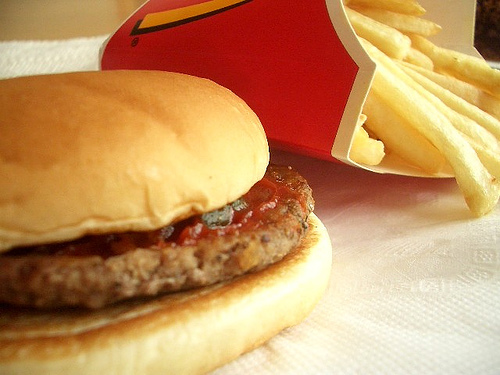
A Hamburger
Coffee
A Soft Drink, or
Gummy Bears?
Well, you may be surprised to learn that all but the gummy bears are on the top ten list for most distracting foods to eat while driving, but if you chose coffee, then give yourself an extra two points. Coffee is the number one food distraction for drivers throughout the country
It may also shock you to learn that food distractions cause 25 percent of all car accidents — over a million and a half each year!
You’ll notice that all of the top ten distracting food items are messy. Messy foods are the type of food you might spill (very distracting!), then try to clean up (a safe-driving impossibility!). If you gotta eat on the run, take five, then drive — as in, park for five minutes to eat your food before you drive. You’ll thank yourself later for two reasons — first because you can actually relax for just a moment in our fast-paced world, and second because you won’t have to worry about getting that cinnamon roll frosting out of your dashboard after a near miss.
Keep drinks in spill-proof containers, too, so you can keep your eyes on the road without worrying about where that spill is headed.
It’s really a choice between eating your food or filling out accident reports. We don’t have to ask you which you prefer. It’s a no-brainer.
Central Avenue Automotive, along with AutoNetTV, wants you to keep both eyes on the road. Please don’t eat while driving and stay smart.
Some of us just love tires. All those little rubber hairs on new tires and the smell… it’s wonderful. We live in a great time for tires. No matter how you drive, where you want to go, or the look you’re after, there is a tire for you.
The same is true about wheels. The hardest part is choosing from the thousands of wheels available.
We may not be able to help with that, but we can help you get some things in mind before you consult with your Kent tire professional. Let’s start with function and think about how you drive.
For example, maybe you have a large SUV but you don’t drive off-road, so an off-road tread isn’t important. Also, because you are not out bouncing over rocks in the WA backcountry, you don’t need a high profile tire to protect your rims. So that means you can probably go with the low-wide look.
If you have a winter season with rain and snow or if you find you need better ice and snow performance, they make great, high-performance snow tires that won’t make it look like you are driving a tractor.
There really are a lot of options for any given vehicle. You will find it very helpful to have a discussion like this with your Auburn-area tire pro when you need new tires. You can find the best solutions for your driving needs and to make improvements in ride or handling.
Picking a wheel that is the same size as what you are using now is pretty simple. But, it gets trickier if you want to upsize. Just get some help when you go bigger. The tire and wheel still need to fit in the available space. You do not want your tires to rub when you turn or hit a bump. You also need to make sure your brakes and suspension bits will fit with your wheel of choice. It doesn’t matter how great your car looks if it’s not drivable.
Taller, wider wheels and tires probably weigh more than your stock shoes. The “unsprung” weight has a big impact on brake performance. The upsized shoes increase rotational inertia – if you go too big, you may need to upgrade your brakes to compensate.
Another possible problem is an inaccurate speedometer. This happens because the number of rotations can change with the new wheels. Fortunately, speedometers and odometers are all controlled by the engine computer, so it is simple to get it reprogrammed and compensate for the bigger tires.
No matter what you’re after — low cost, long life, high performance, traction, or stunning good looks — your wheel and tire professional at Central Avenue Automotive in Kent, WA can help you identify your needs and give you a custom fit. With all the options available, you don’t have to compromise. There is a tire out there with your name on it!
A lot of us Kent auto owners like our vehicles to reflect our personalities. We’re picky about color and body style. We’ll customize anything from floor mats to window tints to license plates. One popular way for WA auto owners to customize a vehicle is to get new wheels.
Wheels come in thousands of designs. Custom wheels can add personality, style or sass to a vehicle. Many of these customizations involve getting a bigger wheel.
Fifteen or sixteen-inch wheels used to be the factory standard, But today, because a lot of Kent auto owners like the look of larger wheels, many vehicles are available with seventeen or eighteen-inch wheels. Optional wheel packages of twenty inches or more are also available in Kent.
If you want to upsize the wheels on your current vehicle, however, you should know it’s not a do-it-yourself project. There are critical factors involved in ensuring your wheel change doesn’t jeopardize the safety of your vehicle.
First of all, it’s vital for WA motorists to understand rolling diameter. The rolling diameter is the overall height of a tire. If you increase the rolling diameter of your tires when you upsize your wheels, you may have to modify your suspension to make sure the larger tires fit in the space and don’t rub in turns or over bumps. If that’s more work than you’re willing to do or pay for, then you need to maintain rolling diameter when you change your wheels.
It’s not as hard for Kent auto owners as it sounds. Imagine a doughnut. That doughnut represents rolling diameter, so you can’t make the doughnut bigger. However, you can increase the size of the doughnut hole. That gives you a bigger wheel. Tires with reduced sidewall on larger wheels will preserve your rolling diameter.
Rolling diameter is important because your wheels and tires still need to fit inside the wheel well. Also, your speedometer, odometer and anti-lock brakes are all programmed to work with a specific rolling diameter. You’ll throw off the readings on your speedometer and odometer if you change your rolling diameter. And for your anti-lock brakes to work properly, your rolling diameter has to be within 3% of factory recommendations. While some Kent car owners who upsize may not be concerned about meter readings, throwing off the brake system is a serious safety hazard.
Further, many vehicles in Kent are now equipped with electronically controlled suspensions. Changing the rolling diameter will negatively affect this system as well, which can lead to a less smooth ride and lower handling performance as well as detrimental safety concerns.
Your considerate Central Avenue Automotive tire professional may be able to reprogram your vehicle’s computer to adjust for a larger (or smaller) rolling diameter.
So to maintain rolling diameter, you’ll need tires with a shorter sidewall. These tires will be designed to give the sidewalls the strength they need to maintain ride quality. Consider that doughnut again. As the wheel (the doughnut hole) gets bigger, the sidewall of the tire (the width of remaining doughnut) gets shorter. That means the tire holds less air. The sidewalls have to be made stiffer to compensate for the decreased air capacity.
To improve their strength, the shorter tires will also be slightly wider than your previous tires. But this means you’ll have a larger contact patch, or, in other words, a larger area of tire making contact with the road. This can actually increase your handling performance and decrease braking distances. Many WA auto buffs customize their wheels just for this reason—they want the improved performance rather than looks or style. If you drive a truck or an SUV around Kent, you might be interested in the extra control an upsized wheel can provide.
Now, that larger contact patch still has to fit inside your wheel well without rubbing when cornering or when bouncing over bumps or potholes on Kent roads. This is termed fitment, and you may need a few essential adjustments so your new wheels will fit properly. You may need spacers so that your brakes will fit inside the new wheels, as well.
Central Avenue Automotive tire professionals are experts at mounting, adjusting and customizing wheels. They can give you a lot of good auto advice about wheels and tires and how they affect driving performance and car care. They can help Kent car owners select wheels and tires that will suit their driving needs and habits.
For example, if you drive off-road around Auburn, you should consider a higher profile tire. This type of tire will protect your rims from costly damage while you’re bouncing over rocks. Or, if you tow a trailer or haul heavy loads around WA, you’ll want a tire with a load rating equal to your demands. Your considerate Central Avenue Automotive tire professional can help you with these types of concerns.
Once you’ve got your new wheels, have your considerate Central Avenue Automotive service advisor inspect to see if you need an alignment. You don’t want those new wheels and your higher performance compromised by poor alignment. Get the most out of your investment by getting the work done right at Central Avenue Automotive in Kent.
Last but not least, remember tire pressure. With larger wheels, your new tires will hold less air and they’ll need slightly higher pressure. You’ll need to stay on top of vital preventive maintenance and keep them properly inflated. Be sure to check their pressure at least once a week. If you don’t keep your tires at their correct pressure, they will wear out really fast. It will also lessen your braking and handling performance.
So smile and show off your vehicle around Auburn. Make it all yours. Bumper stickers, vanity license plates, custom wheels — strut your stuff!
When it comes to their vehicles, some auto owners don’t have an auto maintenance mindset. They know they need to take care of their cars, but it’s always very difficult to get them to remember to do it. Auburn drivers generally accept that many things in life require regular maintenance, but just may have not applied it to their SUVs.
For example: the lawn. You water it and mow it every week. You weed the flower beds and rake the leaves. This is just one of the things that Auburn residents are diligent about. Going to the dentist twice a year. Clothes to the dry cleaner. Flu shots. Taking the kids to the doctor for a checkup before school starts.
If they do all this, then they are, in fact, maintenance-minded. They just have to learn to apply that mindset to cars. I mean, if you never brush your teeth or go to the dentist, you’ll become painfully aware of your neglect when you get a big cavity. Once the damage is done, most of us learn our lesson and shape up.
Unfortunately, car owners too often learn a hard automotive lesson when they bring their vehicle to Central Avenue Automotive on a tow truck. So many times a little routine auto maintenance would have prevented a breakdown.
So how can local drivers get into the habit of taking care of their SUV? It’s so easy to forget. If you skip cutting the grass, you see it every time you pull in the driveway. The same can’t be said for a car that may not show any outward signs of trouble.
Here’s something that will help: The key to good vehicle maintenance starts with an oil change. Think about it – when you go in for a full-service oil change, your Central Avenue Automotive tech will check all your fluids. If one of them is low, he can look for the reason why. If your serpentine belt is cracked, he’ll see it and let you know. Corroded battery cable – they’ve got you covered. At Central Avenue Automotive, we check to see if your SUV manufacturer has recommended any services at your current mileage. The oil change becomes kind of a focal point, a way to check in to see what needs to be done. Vehicle inspection surveys consistently reveal that over 80% of vehicles have one or more unperformed repair or maintenance service. Vehicles are generally very reliable and can take a lot of abuse and neglect, but you’ve got to remember that SUVs are complicated machines. There are parts and fluids that are critical to their operation. Without them, the SUV won’t run at all.
So when you come in to Central Avenue Automotive for an oil change, you get an automotive analysis from your considerate service adviser and a reminder for recommended services so you can avoid a total failure. Remember that your Central Avenue Automotive technician can help you work out a maintenance and repair plan, prioritizing and scheduling the work to make sure you and your family are safe, and helping you avoid expensive breakdowns.
Hello Kent drivers! Let’s talk about alignment. One of the most important parts of preventive maintenance for your vehicle is keeping the wheels in alignment. Poor alignment causes your tires to wear unevenly, which can significantly reduce their lifespan. This means you will have to replace them more often, which can be costly in Kent.
It can even damage your suspension system, which is a significant repair. But even more importantly, uneven tread wear can lead to blowouts on the road, a dangerous and potentially deadly safety risk for Kent drivers and their passengers.
It may not take an accident or bad driving habits to “knock” your tires out of alignment. Tires can go out of alignment with just everyday WA driving. Kent road hazards, pot holes, uneven or gravel roads, even the bumps and bounces of normal Auburn interstates and surface streets can gradually put your SUV tires out of alignment.
So it’s good auto advice to have your SUV’s alignment inspected periodically. Your vehicle’s owner’s manual will have recommendations on how often you should get an alignment check: usually every year or two. But if you think your SUV tires might be out of alignment, you should take your SUV into Central Avenue Automotive now.
When you take your SUV in for an alignment in Kent, your considerate Central Avenue Automotive service advisor will start by inspecting the steering and suspension systems. If something is broken or damaged there, it will need to be repaired in order to get good alignment of the wheels.
If all looks good in the steering and suspension departments, the SUV will then be put on an alignment rack where an initial alignment reading is taken. The wheels can then be aligned to the automobile manufacturer’s specifications. The ideal alignment for any vehicle is set by its engineers and may vary from vehicle to vehicle.
There are three types of vital adjustments that may have to be made to correctly align a vehicle’s tires. The first is called “toe.” This refers to tires that are out of alignment because they point inward or outward at the front of the tire. Think of a person who is pigeon-toed or splay-footed, and you get the idea.
The second adjustment is the camber. This adjustment affects the angle at which the tires meet the road. Think of a solid building in contrast to the Leaning Tower of Pisa.
The last adjustment is the castor. This adjustment measures the angle of the tire in relation to the front axles. So, a piece of auto advice that just might be good for life as well: keep everything in alignment, and you’ll be able to steer where you want to go in Auburn. Drive safely.
When all of your vehicle’s wheels are lined up exactly with each other, your wheels are in alignment. Hitting a road hazard or even just the normal bumps and bounces of everyday driving in Kent can cause your SUV’s wheels to be out of alignment.
Driving for an extended time in Kent when your wheels are out of alignment results in uneven tire wear. This is dangerous … and expensive. Worst case scenario, you have a blowout on a crowded WA interstate. It can also cause premature wear to your suspension system, which can be really expensive to repair. At the very least, you may have to replace your tires years too early.
Here are some alignment basics from Central Avenue Automotive:
The first adjustment is called toe or do the wheels point in towards each other or away from each other at the front of the tire. The next adjustment is called camber or do the wheels tip in or out at the top. And finally, there is castor. Castor measures the angle where the front axles attach to the vehicle.
The ideal alignment for your SUV was designed by its engineers. Alignment service at Central Avenue Automotive starts with an inspection of the steering and suspension – to see if anything’s bent or broken. Then your considerate Central Avenue Automotive technician will look at tire condition.
From there, the SUV is put on an alignment rack and an initial alignment reading is taken. The wheels are then aligned to SUV car makers’s specifications.
Your SUV owner’s manual probably has a recommendation for how often your alignment should be checked – usually every couple of years. If you suspect an alignment problem, get it checked at Central Avenue Automotive before you suffer expensive tire or suspension damage.
Practically anyone who owns a car has asked this question: “Will using premium gas make my car run better?” The answer is simple, but first, let’s talk about what exactly premium gasoline is.
Different grades of gasoline have different octane ratings. Regular gasoline has the lowest octane rating and premium the highest. Most gas stations in the Kent area also carry a mid-grade that falls in between the two. The octane range for the different grades of gas varies by region due to altitude differences.
Engines require different octane ratings because of design differences. For example, turbocharged engines usually require premium gas.
There’s a sticker on your gas tank filler lid that tells you the minimum octane rating your manufacturer recommends.
Read your owner’s manual carefully to see if it’s acceptable to use lower grades. With some cars in it is — the engine control computer can adapt. You’ll lose some performance, but it won’t do damage. With other engines, using a lower grade of fuel could result in serious damage, so you don’t want to save a couple of bucks at the pump only to pay it out a hundred fold at the repair shop. Your car will run best on the grade of gasoline recommended by the manufacturer.
Today’s computer controlled vehicles are optimized to run well on the recommended grade of fuel. Using a higher grade than is recommended will not give you any additional performance or better fuel economy.
Regulations require detergents for all grades of gasoline, so your engine will have the same protection, regardless of the grade of fuel you use. If you do hear some knocking or pinging from your engine, take it seriously and get your SUV into Central Avenue Automotive. It may be a sign that you need a tune-up or some other repair.
In times of high gas prices, we’re all conscious of making our fuel dollar go further as we drive around Kent. Be sure to use the right gas for your car. Keep your tires properly inflated and your vehicle well maintained and you will get the best fuel economy possible.
A. A filter for your Kent house? B. A fresh, piney scent? C. A filter for the passenger compartment of your car?
Clever you, it’s C.
A cabin air filter cleans the outside air before it comes into the passenger compartment of your SUV. It filters out common Kent air particles like dust, pollen, spores, bacteria, pollutants, exhaust gas, odors and even sparrows.
These high tech filters can block particles larger than 3 microns. By contrast, a grain of sand is about 200 microns.
Not all Auburn car owners have cabin air filters. They are fairly new on the scene in WA. Last check, about forty percent of new vehicles sold in Kent come with cabin air filters, but the number is growing every year.
Cabin air filters make driving a lot more pleasant for Kent auto owners. Your SUV can be a haven during our Kent allergy season with very little dust and pollen getting into the cabin. Of course, like all filters, the cabin air filter eventually gets clogged. When this happens, your heating and air conditioning flow can become restricted. The filter can even get kind of smelly.
Check your owner’s manual for replacement guidelines. If your SUV owner’s manual doesn’t mention your cabin air filter, ask your considerate tech at Central Avenue Automotive for a recommendation. It’s usually every year or 12,000 miles / 19,000 kilometers. Change it sooner if you drive in dusty conditions around the Kent area, or if you start to notice a funky smell coming from your vents.
The team at Central Avenue Automotive urges Kent drivers to keep their cabin air filter cleans. It may not help with your brother-in-law in the backseat, but it will make your driving experience around Kent more enjoyable.
Come by Central Avenue Automotive in Kent and we’ll take a look at your cabin air filter for you.
No matter how well they’re made, cars are bound to have problems with their design or manufacturing. When the government thinks a problem is really serious, they require the manufacturer to issue a vehicle recall notice to vehicle owners and to fix the car free of charge. The manufacturer then tries to contact everyone who owns that type of car in Kent and elsewhere until the work is done. If you have questions about vehicle recalls, give us a call at 253-854-6762.
These vehicle recalls always affect safety, so you need to take them seriously. It’s really easy to find out if a vehicle is being recalled. For links to government sites, take a look at the AutoNetTV website. Other helpful website include: carfax.com; autobytel.com; and dmv.org. All of these sites have free recall searches.
Recalls are pretty serious and don’t happen all that often, but sometimes cars have less serious problems that you still might want to know about. In this case, manufacturers issue what is known as a Technical Service Bulletin – or TSB. These bulletins tell service centers how to repair a problem that occurs frequently or is especially difficult.
The pros receive updated information through subscription plans, which are sometimes available in consumer versions too. You can buy access to these for an annual fee.
Whatever your source, pay attention to any vehicle recall in order to keep you and your passengers safe.
Most Auburn car owners know that tires wear out and that the wear has to do with tread depth. Most of us have heard that “bald” tires are dangerous, but most of us picture a tire with no tread at all when we think of a bald tire. And when we take our vehicles in for preventive maintenance, the technician tells us they’re need to be replaced long before all the tread is worn off. Just how much tire tread wear is too much? And how can you tell? Tires are costly and their condition is important to the safe handling of a vehicle, so it’s vital for Auburn auto owners to know the answers to these questions.
First of all, it’s vital to understand that there may be a legal limit to tread wear. If your tires are worn past this limit, you have to replace them to be in compliance with WA auto safety laws. That’s why measuring your tread wear is part of a vehicle safety inspection.
In some jurisdictions, tread must be at least 1.6 millimeters or 2/32 of an inch thick. This standard has been in effect since 1968. But this standard has recently been called into question, and some Kent car owners are arguing that it be changed.
The safety issue that has brought this standard under scrutiny is the ability of a vehicle to stop on a wet surface. When a vehicle has trouble stopping, most Kent car owners immediately look at the brakes as the source of the problem. But tires are crucial to safe stopping distances because they provide the traction required in a stop.
A tire’s contact with the road surface creates traction, which allows for effective braking. On a wet surface, a tire only has traction if it can get to the road’s surface. So tire tread is designed to channel water out from under the tire to allow it to stay in contact with the road. If the tire can’t shift the water, then it starts to “float.” This condition is called hydroplaning. It is very dangerous for Kent auto owners since the vehicle won’t stop no matter how hard the driver presses the brakes. Steering control is also lost.
A recent study tested the stopping ability of a passenger car and a full-sized pick-up on a road surface covered with only a dime’s depth of water (less than a millimeter). The vehicles were traveling at 70 mph (112 kph) when they stopped on the wet surface. At 2/32 tread depth, the stopping distance was double that of a new tire. The passenger car was still traveling at 55 mph when it reached the stopping distance it experienced with new tires.
Let’s suppose that you’re on a busy Auburn expressway in a light drizzle and a vehicle stops suddenly in front of you. You just bought new tires and you brake hard, missing the vehicle with only inches to spare. If you hadn’t bought those new tires, you would have crashed into that vehicle at 55 mph. That is a major difference.
What if your tires had a tread depth of 4/32? You would have crashed into that vehicle at 45 mph. Still not a good situation. But it’s better.
Now what if you were driving that pick-up truck? You wouldn’t have missed that vehicle in the first place, and you would have crashed at higher rates of speed in both of the other scenarios. The heavier your vehicle, the longer its stopping distance. It’s a matter of physics.
The results of this test has led Consumer Reports and others to ask that the standard for tread wear from 2/32 to 4/32. The increased standard will improve safety on the road and save lives here in WA and nationally.
Of course, until the standard changes, you’ll have to decide whether you’ll be willing to replace your tires a little sooner.
You can use a quarter to tell if your tread wear is down to 4/32. Place the quarter into the tread with George’s head toward the tire and his neck toward you. If the tread doesn’t cover George’s hairline, you’re under 4/32. With a Canadian quarter, the tread should cover the digits of the year.
You can measure the 2/32 tread wear with a penny. If the tread touches the top of Abe’s head, it’s at 2/32. Tires are a significant item for Kent auto owners when it comes to car care. But their condition has a major impact on safety. We need to decide whether to sacrifice safety for economy. Keeping our tread wear above 4/32 is good auto advice.
Central Avenue Automotive is ASE Certified, and AAA Auto Repair center. We are a Better Business Bureau Accredited Business with an A+ rating and Authorized Vehicle Emissions Repair Facility.
Central Avenue Automotive is an ASE Certified, and AAA Approved Auto Repair center. We are a Better Business Bureau Accredited Business with an A+ rating.