Posted by & filed under Service Standards, Shocks & Struts.

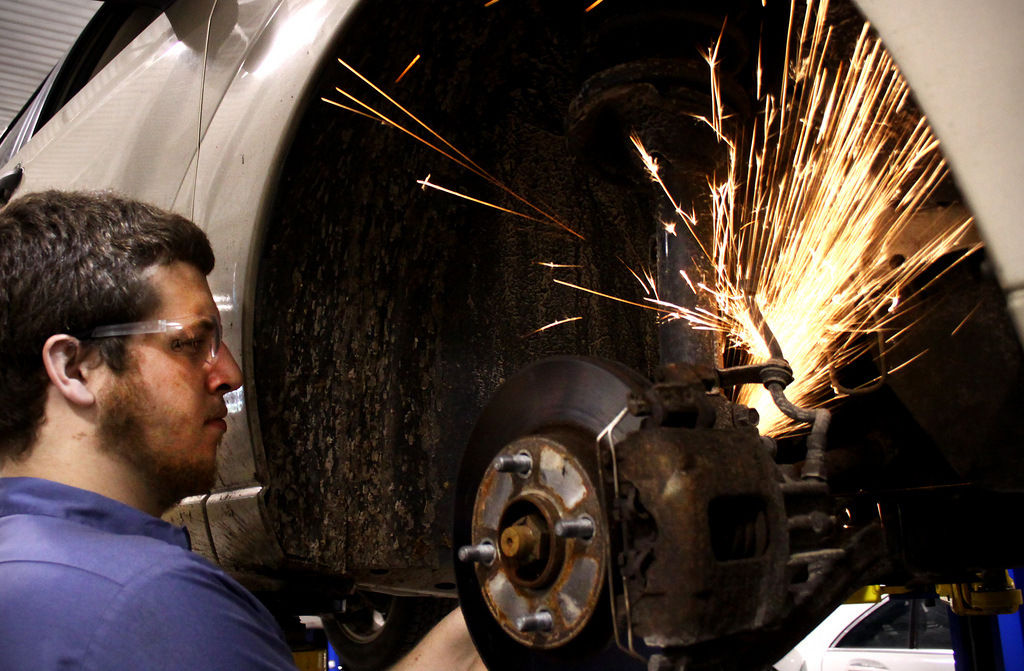
When you hear the word “suspension,” you may think back to those energetic days of grade school. Well, suspension service for your car is actually a good thing because it keeps it up off the road and helps provide a comfy ride. The suspension system needs to keep your wheels firmly planted over bumps and through curves, and it has many parts. If you look under your car, it’s basically everything that connects your wheels to the car’s frame. These are heavy duty parts that do a lot of work. They need to be inspected for damage and excessive wear at least once a year. A good time for this is when you get your annual alignment service.

Here are some warning signs that your suspension may have problems:

  • the car pulls to one side
  • it wanders
  • the steering is erratic
  • you see uneven tire wear
  • you experience a poor ride or handling
  • you see oil leaking from shocks

. . . You just don’t feel in control when you’re driving.

suspension service

Some suspension parts just wear out with use. Shocks and struts eventually lose their ability to control your ride. Wheel bearings need to be repacked every couple of years. And some suspension pieces need to be lubricated when you get your oil changed. Your service adviser at Central Avenue Automotive can oversee an inspection and tell you what problems you may have.

If you’re in an accident, your suspension can be damaged or knocked out of alignment. Even a minor accident, like hitting a curb or even a large rock can mess things up. With a minor accident, it’s tempting to just get an alignment or wheel balance to correct the problem. But if there’s some damage, a simple alignment won’t actually fix the issue, and you’ll just have to align it again after the repairs are made. So if you have an accident, get a suspension service so your system is inspected right away. Suspension problems should be fixed immediately because they can lead to unsafe handling.

One big cause of suspension damage is potholes – those nasty magnets that seem to draw our tires right into them. Here are some tips for avoiding damage from potholes: first, keep your tires at their full air pressure. That gives tires their maximum resiliency and will hopefully keep your wheels or other suspension parts from crunching on a big hole. Next, just pay attention. When you see a hole you can’t miss, slow down before you hit it. Driving at a slower speed will limit the damage and may keep your drink from spilling. Don’t brake directly over the pothole. That will cause the car’s weight to shift forward and add to the potential damage.

If you find yourself in need of suspension service, give us a call today at 253.854.6762 or stop by at 1514 Central Ave S Ste A, Kent, WA 98032.

Posted by & filed under Service Standards.

Buying a new car is always a big financial decision. The allure of that new car smell is powerful, to be sure. But what if your current car is still in good shape? How do you decide?

People who’ve been used to driving a new car every three to five years may be having second thoughts in this economy. For many, the question is, how does the certainty of a new car payment stack up against uncertain car maintenance costs for a car that may be out of warranty?

For purposes of our discussion, let’s assume you live right here in Kent and have a five year old vehicle. It’s now paid off. If you keep it, you fear that there’ll be some repairs over the next five years, but you really don’t know what to expect. For help we turned to Edmunds.com.

Edmunds.com has compiled maintenance and repair information for cars and trucks. With this data, they project likely service and repair costs for a particular make and model. They’re able to use manufacturer’s maintenance schedules and repair histories for the projections.

Of course, these projections can’t predict what will happen to your vehicle, but they do give you information to use in your decision.

Let’s look at the numbers for a five year old Toyota Camry V-6. In this example, the combined maintenance and repairs for the five year period is $5,748. This works out to an average of $96 a month. The year-by-year averages range from a low of $49 a month to $124 a month.

So compare $96 a month with a new car payment. It’s actually better news than that; you would still have car maintenance expenses with a new vehicle, so the repair element could be less than half that figure.car maintenance economics

Here are numbers for some other five year old vehicles:

  • Ford Escape – $116 a month
  • Chevy Silverado – $131 a month
  • Jeep Grand Cherokee – $138 a month
  • Hyundai Accent – $85 a month.

Now, if your vehicle is older than five years, have a chat with your service adviser at Central Avenue Automotive. We see hundreds of vehicles through our bays every month and we know your car. See if there’s any particular problem common with your vehicle that you might see over the next couple of years.

And of course, the best way to keep future repair costs down is to take care of all your scheduled maintenance. This is especially important in older vehicles that have had time to accumulate some deposits.

There are special motor oil formulations that help clean older engines and protect and recondition their seals and gaskets.

We hope this eliminates some of the unknowns in the decision to keep or trade. Contact us today if you have any questions!

Photo Credit: swong95765 via Compfight cc

Posted by & filed under Inspection.

Your browser does not support video

There are a lot of things in life that Kent residents have to do on a regular basis. We wash dishes every day, do our laundry and mow our lawns every week, and pay the bills every month. We should go to our Kent dentist twice a year and see our doctor for a check-up once a year. When we don’t stay on schedule with these routines, it can lead to embarrassing, painful or expensive consequences.

Scheduled maintenance is also part of good car care. Kent drivers should take their SUVs in regularly for a good check-up. But many Auburn folks struggle to remember, or actually even ignore, this auto advice. When it comes to our cars, we’re more likely to listen to “If it ain’t broke, don’t fix it” than “An ounce of prevention is worth a pound of cure.” Yet it is the second adage that is the more applicable one.

Regular brushing treatments prevent cavities. Filling a cavity prevents a more painful and more expensive root canal. In the same way, replacing coolant/antifreeze, for example, vehicle can prevent cooling system leaks. Repairing leaks can prevent engine failure. So why do we procrastinate?

One reason might be that “ignorance is bliss.” We can see dirty dishes on the counter and how long our grass is getting; we can smell how dirty our clothes are; but we don’t notice how dirty our transmission fluid is getting. However, trouble in our SUVs is like trouble in our bodies—ignorance is not bliss. High blood pressure can lead to heart damage, and inadequate coolant can lead to engine damage. However, we can’t know about either one unless we take the time for a diagnostic check-up at Central Avenue Automotive in Kent.

Another reason us Kent drivers put off scheduled maintenance for our vehicles may be that we are simply intimidated by automotive care. After all, we understand how to take care of clothing, dishes, lawns, etc. Most of us have a basic working knowledge of our bodies and feel qualified to explain how we feel. But our vehicles? What exactly does routine, preventive maintenance involve? Most Kent drivers don’t know.

Of course, our SUVs come with owner’s manuals that do a good job of explaining what routine maintenance is and how often our vehicles need it. But how many Kent drivers actually read them?

The good news is that all Kent auto owners have to do is remember to take our vehicles to a reputable, service center like Central Avenue Automotive in Kent. Like a good doctor, your considerate Central Avenue Automotive tech will be able to tell you what maintenance and service your car needs and when. The service center can track your car’s maintenance records—just as a doctor maintains your health records—so that your vehicle is getting the service it needs in a timely manner.

Here are some guidelines to help Kent car owners understand the basics of preventive maintenance: Fluids. If it’s a liquid, it has to be replaced regularly. Your owner’s manual will tell you how often. Liquids include oil, transmission fluid, coolant, power steering fluid, brake fluid and differential fluid. There may be others. Check with your owner’s manual or your service center for specifics on your vehicle.

Tires. They need routine, scheduled care to wear well. Primarily, they need air. But they also need to be rotated, balanced and aligned.

Brakes. Brakes and shock absorbers wear out. There’s no way to avoid it. Worn parts need to be replaced.

Fuel. Obviously your SUV needs gas on a regular basis. But the fuel system also needs periodic maintenance. Air filters and fuel filters get dirty and need to be replaced. The fuel system needs to be kept clean.

These are the basics of car maintenance. Of course, there are other parts of your car that need to be inspected regularly, such as the battery, exhaust system, belts, etc. These parts have longer life cycles than your fluids, tires, brakes and filters, and so don’t need to be replaced as often.

If you are taking your SUV in for the basics, then your Kent service center will let you know when it is time for an inspection of these other things. Or they may notice a problem when doing routine maintenance and let you know. Either way, you’ll get a heads-up when your vehicle needs more attention.

If you’re not convinced yet that your SUV needs regular service, consider this: not doing so will cost you in decreased fuel economy, lower performance and compromised safety. These could lead to costly repair bills and costly accidents.

Just like a good dental check-up, a good auto check-up at Central Avenue Automotive in Kent can save you from experiencing embarrassing, costly and painful situations.

Posted by & filed under Service Standards.

Make an appointment with Central Avenue Automotive to have your on board diagnostics analyzed.
1514 Central Ave S Ste A
Kent, WA 98032
253.854.6762

Today we’re going to talk about on-board diagnostics and the questions we hear from folks around Kent WA who need answers about diagnostic services. They want to know what diagnostics are, what’s involved and what the benefits are. They really want to understand the value of diagnostic scans by a trained technician in Kent WA.

These are valid concerns. If you don’t understand something it’s really hard to know its value. Let’s start with some history.

Since 1996, all cars and light trucks in Kent WA have been required to use a standardized diagnostic system to help repair technicians determine what’s wrong with your vehicle. The diagnostic system works with the vehicle’s Engine Control Module – the computer that controls many engine functions.

The computer monitors dozens of components and processes. Depending on what the sensors read, the computer will make adjustments to compensate for conditions and minor problems. When there is a condition that it can’t adjust for, the computer will turn on the check engine light.

It is also called the ‘service engine soon’ light on some vehicles. The warning light signals you to get into your Kent WA service center so that the trouble code can be read and the problem can be fixed. Your service center will have a scan tool and powerful software that will help the technician diagnose the problem.

If you’ve searched for check engine light on the internet, you may have seen that you can buy an inexpensive scanner or go to an auto parts store to have the trouble code read to tell you exactly what’s wrong.

That’s a common myth. The code itself doesn’t tell you what’s broken. It starts you looking in the right place. It tells you what engine parameter is out of range – but it won’t tell you what’s wrong or how to fix it.

Let’s say you think your daughter has a fever. You take her temperature and it reads one 102 degrees. You’ve confirmed a fever, but you don’t know what’s causing it. Is it a 24 hour flu, an infection, appendicitis or leukemia? A fever is a symptom of all of these medical problems, but it takes a skilled physician’s examination and additional diagnostic tests to find out what is actually causing the fever.

An example of a trouble code could be: P0133, which reads ‘Bank 1 sensor 1 circuit slow response’. This means that the front oxygen sensor has a slow response time to changes in the air-fuel mix. If that’s all you knew about cars, you would think your oxygen sensor was broken and would replace it. Now, it could be the oxygen sensor – but it could also be a bad or contaminated airflow sensor, exhaust leak, electrical problem, an intake manifold leak or any of a number of other things.

You can imagine a lot of oxygen sensors have been replaced because of that code. So the on-board diagnostics point the way to where the trouble lies, but it takes some skill and high-tech equipment to actually pinpoint the problem. The cheap scan tools that a consumer can buy do not have the ability to retrieve some of the operating history that’s stored in the engine control computer. That history’s very helpful in diagnosing the problem. Service centers like Central Avenue Automotive invest a lot of money in high-end diagnostic tools to help solve the mystery and get you back on the road as soon as possible without replacing a lot of parts that don’t need replacing.

So, on-board diagnostics provide a powerful starting place for a highly-trained, well-equipped technician to get to the bottom of your problem. When your check engine light comes on, get it checked at Central Avenue Automotive. If the light burns steady – don’t panic. Get in to Central Avenue Automotive soon to have the engine scanned. A flashing check engine light means that there is a severe engine problem. Get in as soon as you can – waiting too long can lead to very expensive damage.

And try to not drive at high speed or tow or haul heavy loads with a flashing check engine light.

Posted by & filed under Drive Train.

One automotive service issue that doesn’t get much attention is driveline service for the drive train. Drivelines don’t get talked about very much around Kent, but they’re very important. First let’s define what the driveline is.

Taking a small step back, the power plant is comprised of the engine and transmission. The driveline starts there and includes all of the components that transfer power from the transmission to the wheels.

That’s not really a lot of components, but they handle the full force of the engine. Without the driveline, you’re not moving. So we need to take good care of it. The driveline components differ depending on whether your vehicle has front wheel drive, rear wheel drive, all wheel drive or four wheel drive. For purposes of our discussion, we’re going to have to oversimplify the drive train a bit.

Let’s start with front wheel drive. The point where the transmission stops and the driveline begins is a little blurred with front wheel drive because the transaxle houses both the transmission function and the differential function. The half shafts that send power to each front wheel, come out of the transaxle. The shaft is connected to the wheel by a constant velocity, or CV, joint. The CV joint is protected from dirt and water by an airtight, flexible rubber boot.

drive train

So, driveline service would include properly servicing the transaxle and inspecting the CV boot to see if it’s torn or loose. If it is, it needs to be replaced and the CV joint inspected for damage. Repairs may be in order. Besides visual damage to the airtight CV boot, you might hear a clicking noise when turning. Recommended maintenance for the transaxle and CV joints will be spelled out in your owner’s manual or check with your service adviser.

On to rear wheel drive. The driveline for a rear wheel drive vehicle starts with the driveshaft – that long tube that connects the transmission with the differential on the rear axle. Some vehicles have a two piece drive shaft. The shafts are connected to the transmission and the differential with big universal joints. You’ve probably heard the term ‘u-joints’. These joints can wear out, just like the CV joints in front wheel drive vehicles. You may hear some clunking or feel a jolt when shifting into drive or reverse – if you do, get your driveline inspected.

The differential on the rear axle sends power out to each rear wheel through half shafts in the axle. The differential fluid needs to be drained periodically and replaced with clean fluid. When the seal on the end of the axle is damaged or leaks, the axle will need to be serviced. The routine maintenance item here is differential service. Be sure to check your owner’s manual or Kent service adviser for intervals.

Now let’s go on to all wheel drive. Remember that the difference between all wheel drive and four wheel drive is that an all wheel drive vehicle is essentially providing power to all of the wheels all of the time. The vehicle may be able to shift more of the power to the front or to the back depending on where you need traction. All wheel drive vehicles are designed to work well on dry pavement. Even some high-end sports cars from makers like Lamborghini and Porsche have all wheel drive.

Some all wheel drive vehicles are designed to work well off-road, but all hard-core rock crawlers are four wheel drive. These guys thrive in mud, sand, rocks and hills – but they don’t work well on dry pavement when they’re in four wheel drive. So they have the option to shift to rear wheel drive only on dry pavement.

Most all-wheel drive vehicles are very similar to front wheel drive when it comes to the front end. They also have a center differential that transfers power to the rear differential. Connecting it all is a shaft from the transaxle to the center differential and another from the center differential to the rear differential. So all of the normal front wheel drive service is required as well as service to the center and rear differentials.

Four wheel drive can be thought of as a rear wheel drive vehicle that can also send power to the front axle. There’s a transfer case in the middle of the vehicle that can be shifted to send power through a drive shaft to a differential on the front axle. So you need differential service for the front and rear differentials and for the transfer case as well.

The bottom line is that the maintenance schedules are in your owner’s manual. Your Kent service advisor can answer any questions you’ve got. If this is the first time you’ve heard some of this stuff – it’s time to ask someone at Central Avenue Automotive if any of it needs to be done now.

Watch our auto tips video from AutoNetTV.

Photo Credit: Powhusku via Compfight cc

Posted by & filed under Alignment.

Auburn auto owners may have an alignment problem if their car drifts or pulls to one side, the steering wheel’s off center, they notice uneven tire wear or the car doesn’t feel like it handles right as they drive down Kent, WA streets and interstates.

When all of a vehicle’s wheels are lined up exactly with each other, your wheels are in alignment. Running into potholes, smacking a curb or other objects around Kent, WA are great ways for Kent drivers to knock their car out of alignment. Then one or more of your wheels starts pulling in a slightly different direction and the problems begin.

The team at Central Avenue Automotive in Kent wants you to know that driving for an extended time when your car is out of alignment causes your tires to wear unevenly and excessively. Sometimes the tire can be worn so badly that it will fail.

At the very least, Kent drivers who drive with wheels out of alignment will have to replace their tires sooner. You could end up with premature wear to your suspension system, which can be pricey. The front wheel alignment is adjustable on all vehicles, and the back wheels are also adjustable on some cars.

Now, let’s discuss some alignment basics. Wheels are adjustable for toe, caster and camber. The ideal alignment for your car was designed by its engineers.

So, what is involved in an alignment check at Central Avenue Automotive in Kent? First, there’s an inspection of the steering and suspension to see if anything is bent or broken. Tire condition will also be evaluated.  Next, the vehicle is put on an alignment rack and we take an initial alignment reading.

If all four wheels are adjustable, they are lined up perfectly parallel with the vehicle’s centerline. If the back wheels aren’t adjustable, the direction they push is determined and the front wheels are aligned to match.

Like most things, vehicle manufacturers have recommended a mileage interval for having alignment checked. But if you run into a curb, pothole or something else that’s given you a big jolt, pay attention to whether your vehicle is pulling to one side when you drive around the Auburn area. It’s better for Federal Way auto owners to have their alignment checked before waiting to see if there is uneven tire tread wear – by then, the damage is done.

Getting your alignment checked at Central Avenue Automotive when necessary is a great way to extend the life of your tires and suspension parts. It also makes sure that your tire meets the road properly for maximum performance and safety in WA.

Come see us at  for more information about your tire alignment. We look forward to serving you.

Posted by & filed under Brakes.

Good brakes are obviously very important. If you’ve ever had your brakes go out while you’re driving around the Auburn area, you’ll know how terrifying it can be. Today we’ll focus on how to tell when you have a brake problem, and how to make good repair choices.

Often, the first indication that something’s wrong with the brakes is an unusual sound. It could be a squeal, chatter or grinding sound.

Some brake pads have a little piece of metal embedded in them that will make a squeal or chirping sound when the brake pads have been worn down to the point that they need to be replaced. It’s an early warning indicator.

fixing brakes

When you hear that sound, schedule an appointment at Central Avenue Automotive soon.

Now a chattering sound is more urgent. That usually indicates that something is loose. It could be a brake pad or even the brake calipers. If one of those parts falls off, you could have some serious trouble stopping the vehicle. It would be a good idea to park it until you can get into the shop.

A grinding noise usually means that the brake pad is completely worn away and the metal parts of the brake are rubbing directly on the metal brake rotor. That means the rotor is being damaged and will need some work. More on that later.

Another warning sign is that your brake pedal may feel soft and spongy – or it may even feel very hard to push in. Both could mean trouble. And of course, you may get a dashboard brake warning light.

Now when it comes time to replace your brake pads, you have a choice to make. You can get the same pads that came standard on your vehicle. You can expect the same performance and durability as with the pads that came on the car from the factory.

Now you can also get a budget brake pad. Sometimes drivers insist on lower cost pads. That’s OK if the budget demands it, but you need to be aware of the trade offs. Lower grade pads are usually noisier, so you’ll have to live with more noise when you apply the brakes. They also tend to generate a lot more brake dust, you know, that black dust that accumulates on your wheels. And they probably won’t last as long either. In our opinion, that’s a lot of compromise for just a few dollars in savings.

You can also choose to buy premium brakes pads. These perform at higher specifications than the factory pads. You can expect quieter operation, less brake dust and better stopping power.

Now, getting back to the rotors. The rotors are the discs that the brake pads clamp down on to stop the vehicle. If you’ve been driving with completely worn brake pads, you’ve scratched grooves into the rotors. If the grooves aren’t too deep, the rotor can be resurfaced. A thin layer of metal is cut off the surface of the rotor to make it smooth again.

Now, if the grooves are too deep or if the rotor has already be resurfaced before, there may not be enough material to resurface and still have a rotor that’s thick enough to safely stop the vehicle. In that case, the rotor will have to be replaced.

Something that’s often overlooked is the brake fluid. Your manufacturer has a recommended schedule for evacuating the old brake fluid, cleaning the system and refilling it with fresh brake fluid. This is really important to brake performance.

So here’s the bottom line: if you suspect, inspect. If you notice any of these warning signs, have your brakes inspected. Your advisor can help you make the repair decision that’s right for you.

Posted by & filed under Maintenance.

A lot of our readers have asked whether or not they should use their severe service maintenance schedule, which is listed in their car owners’ manual. It can be confusing. Let’s clear the air on this subject.

Cricket Killingsworth is from QMI/Heartland, a manufacturer of automotive products and fluids. She’s been in the automotive business for 20 years and is a speaker, a trainer, and a writer. Cricket says there’s so much confusion on this topic because, “Most owners’ manuals actually have two maintenance schedules. Sometimes these are called ‘regular service’ and ‘severe service’. Sometimes they’re simply called Schedule 1 and Schedule 2. A severe service schedule recommends that things like an oil change, air filter replacement, and transmission service be done more often: either in fewer miles or in less time.”

severe service

Manufacturers create these specific schedules for each vehicle they make. So there isn’t one generic schedule that applies to all cars. In addition to your owners’ manual, Kent automotive repair centers subscribe to information services that provide the maintenance schedules for every vehicle – so they can help you know when to take care of needed services. Below is a typical definition for severe service.

  • Most trips are less than four miles
  • Most trips are less than ten miles and outside temperatures are below freezing
  • You drive in very hot weather
  • The engine is at low speed most of the time (not on the highway)
  • Stop and go driving
  • You operate your vehicle in dusty or muddy conditions
  • You tow a trailer, regularly carry heavy loads or carry a car-top carrier

It’s common sense: Just a few minutes at freeway speeds allows the moisture in the oil to evaporate. Very short trips, or trips of less than ten miles when it’s very cold, don’t allow the engine to heat up enough to get rid of the water. And water in the oil leads to damaging sludge. Also, towing and heavy loads raise operating temperatures and cause fluids to breakdown more quickly. Dusty and muddy driving means that more dirt will get past the air filter to contaminate the fuel system and engine oil.

The bottom line is that you need to decide for yourself if the regular or severe service schedule is right for you, based on your driving. Look at your owners’ manual, or talk with your Central Avenue Automotive service advisor who can help you know which schedule to follow. Central Avenue Automotive is located at 1514 Central Ave S Ste A, Kent WA.,

Here is what a fleet manager said recently: “Since city miles are generally tougher on vehicles than highway miles, we use the manufacturer’s severe service schedule as the basis for our preventative maintenance program. We massage those schedules over time, increasing or decreasing the service intervals so that they make the most sense. There is a little bit of art to go along with the science.

Make an honest evaluation of your driving habits. Unless you do mostly WA highway driving in moderate weather, you’ll likely have a fairly good amount of severe service mixed in. Some people just want to play it safe and follow the severe service recommendations, rather than analyzing how they drive each month.

Posted by & filed under Inspection.

A recent report stated that over 80 percent of the vehicles on our Kent WA roads have one or more service or repair that’s needed, but hasn’t been taken care of. Now that’s a lot of undone service. That translates into something over 160 million vehicles in the U.S. alone. Some of the neglected items are minor. Others are serious safety concerns.

There are several reasons why we hesitate to take care of recommended services; especially services that our Kent WA automotive advisor recommends when we’re in for something else, like an oil change.

The first issue boils down to comfort with car care. We don’t always feel we know enough to make good decisions. Some of that can be attributed to the fact that vehicles are so reliable these days. They almost become an appliance. Of course you love your SUV, but if you don’t have to worry about it breaking down all the time, you’re not forced to think as much about preventive maintenance.

Perhaps your dad knew a lot about cars and always made sure they were taken care of. He was very comfortable dealing with his local Kent WA service advisor. People who don’t know as much about cars hesitate to ask questions because they don’t want to look ignorant.

It’s human nature. But, there’s so much to know in this world, we can’t all be experts in everything. So we specialize. It’s very important to ask questions of any specialist, whether it’s your doctor, financial advisor or your automotive technician in Kent, WA.

Your auto technician at Central Avenue Automotive wants your questions. We want you to understand the recommendation and why it needs to be done.

That brings us to the next issue; people say that they don’t always know if they really need the service or if they are just being sold something.

At the heart, it speaks to trust. Do you trust your Kent service center and your service advisor? Trust has to be earned and that takes time and experience. But you can shortcut the process when you realize that most of the recommendations are based on manufacturer’s maintenance schedules.

In other words, “you don’t have to trust me, you can trust your owner’s manual”.

Your Kent service center has computer databases that contain the manufacturer’s recommendations for almost all vehicles, so they don’t need to rummage through your glove box to look for your owner’s manual to know what to do.

Basically, the engineers who designed the car say “here’s when you need to have it serviced”. That’s who makes the recommendation, not the technician. He’s just reminding you.

Now you do need to trust your Kent technician’s experience and judgment from time to time. When he inspects your vehicle, he may find problems or concerns. He will explain things so that you can prioritize the concern and make a good decision about whether or not to have something done.

That brings us to the third issue; money. Often the concern is about spending the money to take care of a recommended service. Our money has many places it needs to go. And we have another list of places we want it to go. Auto maintenance isn’t usually on either of those lists.

Look, everyone who works at Central Avenue Automotive has a family budget, too. They can relate. Maybe a little look behind the scenes would be helpful.

Service centers like Central Avenue Automotive invest heavily in training, diagnostic equipment and tools so that they can make repairs and perform services as efficiently as possible. And like any other business, they have labor costs, insurance, rent, utilities, shop and office supplies, taxes and so on.

We work hard to make sure that we diagnose the problem correctly and fix it right the first time. That’s the only way we can maintain our reputation and remain in business. If we’re not satisfying our customers and providing a good value, you won’t come back and the service center won’t be around for long.

When there is a real budget concern, your Kent service center can help you prioritize the work that needs to be done and come up with a plan for taking care of it that works within your budget.

Let’s say you have a serious problem with your brakes. That’s a safety concern so a technician can’t ethically say, well, let’s put that off for a couple of months. What they can do is take care of the brakes now and address the cabin air filter or transmission service next month.

Posted by & filed under Fuel System.

All modern vehicles come with fuel injection systems, so it’s a topic local drivers need to know something about. The mighty fuel injector is a valve that delivers the gas or diesel fuel to the right place, in the right amount, at the right time, to be mixed with air and burned in the engine.

So how many fuel injectors does your car have? There’s one for each cylinder. So four, six, or eight for most folks. Some vehicles have 10 or 12 cylinders. The engine control computer makes adjustments to the fuel injector as it monitors the engine and other sensors. Fuel injection systems are a pretty high-tech.

Central Avenue Automotive can help area drivers with a fuel injector cleaning service. What’s the benefit? In order to function correctly, the fuel injectors have to deliver the fuel at a precise pressure at a very precise time. The fuel needs to be sprayed in a particular pattern as determined by the engine design.

fuel injection system

Over time, varnish can start to build up in the fuel injectors, affecting the pressure, pattern, and timing of the fuel charge. The result is that the fuel doesn’t get burned as efficiently as it could. That robs the vehicle of performance and hurts fuel economy.

What about dirty fuel – how does that affect the fuel injectors? The fuel injectors are the last stop in the fuel system. It starts at the fuel tank. Frankly, the best way to keep your fuel injectors working well is to use high quality fuel. It’s tempting to shop for bargains in  Auburn with fuel prices as high as they are, but major brands in the area have better detergents and additives and deliver consistent quality.

What about a good fuel filter? The fuel filter is a critical component of the fuel system. Its job is to filter out the dirt and rust that collect in the fuel tank. If it’s clogged up, the dirt will bypass the filter and head upstream to the fuel injectors.

It’s important to replace the fuel filter when your auto manufacturer recommends it. That’s part of a comprehensive fuel system cleaning.

There are different kinds of fuel injection systems. Port fuel injection systems, the kind most gasoline engines have, operate at 60 pounds per square inch. The injectors for the new gas direct injection engines we’re starting to see require 10 to 30 times as much pressure. And some diesel engines for passenger vehicles have injectors that operate at 30,000 pounds or more per square inch. There’s no room for dirt and gum in a precision part like that.

There are a lot of good products available nearby that can clean fuel injectors. They’re best used to prevent fouling in the fuel injectors. Many can’t clean a seriously gummed up injector – that requires a professional deep cleaning, like those we offer at Central Avenue Automotive in Kent. But putting the cleaner in the fuel tank after you’ve had Central Avenue Automotive take a look at your fuel system will help keep it clean. Be sure to read the label for directions.

Give us a call if you think your SUV may be ready for a fuel injector cleaning.

Photo Credit: futureatlas.com via Compfight cc