It’s important for Kent car owners to know battery basics. First, let’s talk about which is harder on a battery – hot or cold WA weather. Most Auburn auto owners think it’s cold weather because that’s when we call on our batteries to have enough power to start a cold SUV engine.
However, heat does more damage to a battery than cold. Truth is, our batteries start to die a little from day one. Keeping a full charge slows the process, which is hard with short Kent trips because the alternator doesn’t have time to fully recharge the battery from starting the engine. Kent car owners can top off the charge with a computer controlled battery charger – say, once a month in the summer and every three months during the winter.
As far as how long a battery will last, statistics show that 70% have given up the ghost within four years. By that time, they aren’t capable of taking a full charge like they used to, and your SUV alternator has to work overtime to keep up. This causes your alternator to wear out early.
If you’re pushing 4 to 5 years on your battery, see your considerate Central Avenue Automotive service professional for a battery test to see if it’s recommended to replace it. Not only can you avoid getting stranded with a dead battery, but you’ll save unnecessary wear and tear on your SUV alternator.
Give us a call
Central Avenue Automotive 253.854.6762 1514 Central Ave S Ste A Kent, WA 98032
Some customers will go one place for their tires, somewhere else for their brakes, yet another place for a quick lube or oil change, and then an auto repair shop for a repair.
It would be better and more convenient if they found a service and repair shop they know, like, and trust. That facility should be in charge of that vehicle from the time the customer purchases it until the time they sell it. It’s always less expensive to do it that way. Having a facility that knows the vehicle and a technician that knows their vehicle inside and out will prevent wasted time, energy, and money.
Most importantly, the technician will know what was done to the car at 30,000, at 60,000 and at 90,000 miles, and will make correct recommendations based on the mileage and the service history.
When you go to a tire store to get your tires replaced, and then you go to a brake store to have your brake pads replaced, and then to a quick lube to have your oil change, there’s no real clear record of what’s been done.
Spreading services across multiple shops takes all of the responsibility of the repairs and places it on the customer to figure out, “What do I need to do and when should I do it?” This often results in finger-pointing and duplicate repairs.
We’ll see cars in our shop all the time with unneeded work done on them. Let’s say we had done a 30,000-mile service to the car, then 5,000 miles later that customer is at a quick lube having an oil change done. That place’s employee tells the customer they need a transmission service, but they had their car serviced two, three or four months ago. They don’t remember if they had the transmission serviced, so they spend another $100-$150 to service it when it was just done.
This is also why it’s so important that the technicians who work on your car have lots of experience and training, and are certified in the area that they repair. Those things are lost when you’re at a quick lube with a 19 to 20-year-old kid changing the oil in your $20,000-$60,000 vehicle. It’s just not something that should happen.
When you go to multiple car shops and have, your vehicle serviced by inexperienced people, you run the risk of paying for duplicate services and repairs. All of that can be avoided by picking one quality repair shop, then having your car serviced there for everything.
Most Auburn car owners don’t even think about their car air conditioning system unless it fails. That’s because many Kent and Burton motorists don’t really understand that automotive air conditioners need periodic service. Let me share some of the reasons why they fail.
First, like every machine, the SUV air conditioner parts need – you guessed it – lubrication. The lubricant is actually mixed in with the refrigerant (that’s the stuff that makes the air cool). Remember that even if the air conditioner is still blowing out cool air, the oil that lubricates the parts may be used up: and unlubricated parts can fail in all WA cars.
Now here’s a tip for Auburn motorists: Run your air conditioner every so often during WA winters. This circulates the lubricant to help keep the seals from drying out.
The air conditioner actually removes some of the moisture in the air. So if you have trouble with fogging on your windshield during WA winters or during a rain storm, running the A/C on the defrost setting should help. Now on some Auburn cars you can’t run the A/C at the same time as the defroster. Don’t ask me why, but I suspect lawyers were involved.
Also, air and water can get into the A/C system. That can reduce the efficiency of the system and also lead to corrosion that causes damage. Auburn drivers should periodically purge the system and replace the refrigerant to remove the air and water.
Kent drivers would be wise to learn the early warning signs of A/C trouble: 1) The air’s not as cold as it used to be. 2) Unusual noises when the A/C cycles on. Those are signs to get your vehicle into Central Avenue Automotive in Kent before the damage gets worse.
By following the recommended service intervals in your SUV owner’s manual, you can help prevent mechanical failure of your air conditioning system. Your A/C system contains some expensive components like the compressor, condenser, dryer, etc. Anything Federal Way and Burton car owners can do to lengthen the life of their A/C is well worth it.
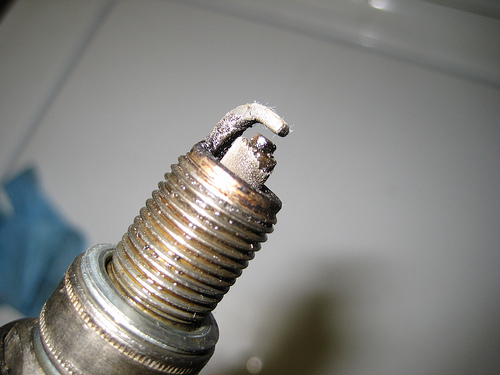
Spark plugs are an important component to keep your vehicle running smoothly, so neglecting them altogether or replacing them yourself may not be the best idea. I’ve seen people go to replace their spark plugs and cross-thread a plug. They’ve taken a very common routine repair and turned it into a big deal.
Spark plugs are commonly neglected, but people think, “The car is running, everything’s fine.” They don’t maintain them, and then it costs more to fix later, especially with Ford products. We also see this with Acuras, as well as some Toyotas. The manufacturer often recommends between 90,000 and 105,000 miles for spark plug replacement.
But what we see happen, especially in Ford products, is the spark plug has been in the vehicle so long, exposed to hot and cold and hot and cold, that it has eased itself into the cylinder head threads. You’re not able to remove the spark plug because it has been in there so long. Now the cylinder head has to be removed, the spark plug has to be drilled out, and then the cylinder head reinstalled. You’ve taken typically a $300 or $400 repair and turned it into a $3,000 repair because you didn’t have the spark plugs replaced by a professional.
Another thing we see often when spark plugs aren’t replaced are secondary failures. Spark plugs have what is called a “coil pack” on top of them. A coil pack is designed to send electricity to the spark plug to ignite the air/fuel mixture in the cylinder. Over time, the spark plug wears out. The spark plug gap — the distance between the electrodes of the spark plugs — increases. As that gap gets larger, it takes more and more energy from the ignition coil to fire that spark plug. It’ll get to the point to where the coil will stop working because it’s been overtaxed — in some cases, for several years. It will just stop working.
Something that would have been a pretty straightforward maintenance repair of spark plugs now requires new spark plugs and four or five ignition coils.
Some cars, like Ford products, will have eight ignition coils if it’s an eight-cylinder, six coils if it’s a six-cylinder and four coils if it’s a four-cylinder. Those can be several hundred dollars to replace. When the coil is damaged, the engine stops firing correctly. Now you’ve got an engine that’s misfiring. A misfiring engine will usually turn on the check engine light, and the check engine light will flash. What that’s telling you is that you are doing damage to your catalytic converter. Most catalytic converters on the low end are $400 or $500. On the high end for some Ford Expeditions, Ford Explorers, Audi and BMWs, you can spend $2,000 or $3,000.
All of this could have been avoided by spending $200 or $300 to replace the spark plugs in a timely fashion.
We’ve seen the whole gamut of issues from people who try to service their vehicle themselves.
A common one is people who try to install their own batteries. When they install the battery, they hook up the cables incorrectly and blow fuses in the car.
Another common occurrence with people who install their own batteries is that they don’t realize that the cars’ computers have to be powered on all the time. They disconnect the battery, which takes the power away from the computer. Then they put the new battery in the car only to find out they’ve lost all their programming. Now the vehicle either won’t start, or the computer needs to be reprogrammed.
Using an example of a Honda Accord: you replace the battery in that car, and if you don’t keep the car powered up, the radio won’t work again. We’ll get a car brought in where the customer replaced the battery and now the radio doesn’t work. We have to remove the radio to get a code on the back of it, then program that code into the front in order to make it work again. Photo Credit: dedi via Compfightcc
We’ve also had cars come in with the brake pads installed backwards. Instead of having the friction portion of the brake pad up against the brake rotor, the metal portion of the brake pad is against the rotor. I’ve even had cars come in where people have rotated the tires and put the lug nuts on backwards, so the tires are falling off the car.
There are a lot of things that happen that don’t need to happen. I think it’s because sometimes people are afraid of the potential cost.
It’s kind of like going to the doctor. If you don’t tell them everything that’s wrong with you, then maybe you’ll still be okay. We all know that’s not true, but it’s something that happens. It’s the same with a car.
If you’re not sure where to go, get some referrals. Talk to your friends, talk to your neighbors, do some online research.
Then go ahead and pick an automotive shop. Pay them a visit, and make sure that you’re completely honest with them. Tell them everything you know about the car. Just that conversation, and you talking it through with a service professional, is really going to help you make a good decision on how you’re going to repair your car.
Hello Kent auto owners! You would never like to drink a glass of mud, right? Well, your SUV feels the same way. It needs a steady supply of clean fuel in order to run well and deliver good fuel economy. The fuel filter’s job is to clean dirt and rust out of the fuel before it gets to your engine. A clogged fuel filter can actually choke off the engine so that it won’t start or run. Some fuel filters have a bypass valve that allows fuel to go around the clogged filter so your car will still run. But, then the contaminated fuel can clog your fuel injectors and allow damaging particles into your engine.
A car with a partially clogged fuel filter might run well around Kent, but sputter and strain on the expressway because it’s starving for gas. There are two things that affect how often you need to replace the filter. They are: where you drive in WA and the gas you buy. If you drive a lot on dirt or gravel roads in rural WA, your fuel filter will have a harder time keeping the fuel clean.
And, we hate to say it, but buying the cheapest gas from bargain Auburn area stations sometimes means dirtier fuel that’ll clog the filter sooner. Major brands tend to be cleaner and certainly have higher levels of detergent additives.
Of course, car makers recommend intervals for changing the fuel filter. But, it’s a little more complicated than that. Some car makers stopped listing recommended intervals for fuel filter replacement or have very long intervals like every five years or eighty thousand miles. So you may need to look to other sources for recommendations. Cars older than six or seven years are especially at risk because they have had time for dirt and rust to build up in the fuel tank. A clean fuel filter keeps the gas flowing. Even a partially clogged filter puts added strain on the SUV fuel pump. That can shorten its life and result in a costly repair.
As is often the case, spending a little money now on something as inexpensive as a fuel filter can save money down the road. At Central Avenue Automotive in Kent, we can check your fuel filter. It is better than fixing a burned-out SUV fuel pump or ruined fuel injectors.
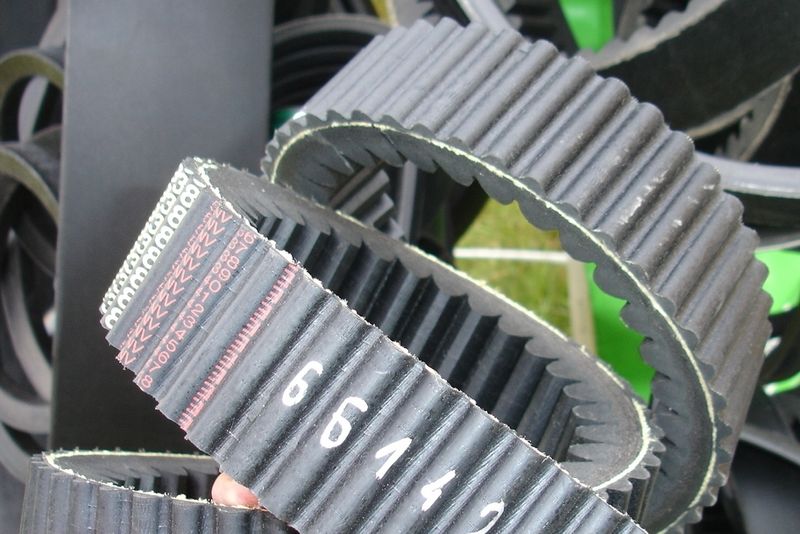
We’re asked a lot of questions here in the shop, and one we hear over and over again is whether or not you should change your water pump when you’re replacing your timing belt. This is a specific question, so naturally it has a specific answer. Unfortunately, that specific answer involves a whole lot of variables. So… not such a specific answer, actually.
The right time to change out your water pump will depend on the make and model of your car, as well as how many miles are on it. This relates to the type of water pump your car uses and if it’s rotated by the timing belt or not. You’ll also have to weigh the cost – is it worth it to wait and come back in six months or not?
Should you replace your water pump and timing belt at the same time?
If your car has 60,000+ miles on it and has already had its first timing belt replacement, as long as none of the seals are leaking and the engine won’t be damaged, it might be worth it to wait and replace the water pump later. Talk to your auto technician about an estimate, and if labor costs are coming in around $200, you should be okay for now. However, if you’re driving a car like an Audi, Mini Cooper, Honda Odyssey, or Acura TL, it could cost more than $400 to come back later for the job. It’s best not to gamble in a situation like that and just get the water pump replacement done at the same time as the timing belt.
If your car is already on its second timing belt replacement, you’ll probably want to replace the water pump and other belts at the same time. Another consideration is what kind of engine your car has. Not all engines are created equal! A lot of smaller cars like the Honda Civic, Volkswagen Jetta, or Acura TSX utilize a high-compression small engine in order to get a little more performance for their size. With an interface engine, the valve opens further into the combustion chamber, so a broken timing belt can cause big problems. A malfunctioning water pump can cause the belt to break, which can cause the piston to strike and damage the valve, which results in major engine repair and major dollar signs.
So, in a nutshell, the answer to the water pump question is “consult your friendly neighborhood auto repair shop.” That would be us. We’ll go over estimates and a recommended plan of action with you. Contrary to popular opinion, we don’t really like having to repair a destroyed engine that could have been prevented, so we’ll be upfront and no-nonsense with you. Give us a call or schedule an appointment online!
Having trouble with your fuel system? Bring your SUV into Central Avenue Automotive for a check up. 1514 Central Ave S Ste A Kent, WA 98032 253.854.6762
In today’s Central Avenue Automotive auto post,we’re talking about fuel system cleaning. The first thing to know is how important it is to have a clean fuel system. Kent car owners need fuel to go, and the cleaner the fuel system, the more efficiently the fuel will burn. That means more power and better fuel economy.
A clean fuel system saves money at the pump. We guess you could say, it all starts and ends at the pump. One of the most important things Kent auto owners can do to keep their SUV fuel system clean is to buy good quality gas. Major brands have detergents that keep gum and varnish from rapidly building up in the fuel system.
So buying cheaper gas in Kent can actually cost more in the long run. Now, most cars on WA freeways are more than five or six years old. That means they’ve had time for some dirt and rust to start accumulating in the fuel tank. This junk needs to be filtered out of the fuel before it hits your SUV engine. That’s the fuel filter’s job.
When the fuel filter is clogged, the dirty fuel will bypass the filter and go on up to the engine where it can clog fuel injectors and get into the cylinders. That could do some damage. So Federal Way drivers should have their fuel filter changed when recommended. Check your owner’s manual or ask your considerate Central Avenue Automotive service professional if your fuel filter is due for replacement.
The fuel then goes up into the throttle body. This is another area where varnish and gum can accumulate. A professional fuel system cleaning at Central Avenue Automotive in Kent will use a combination of special cleaning chemicals and old fashioned swabbing to clean out the throttle body. Now, the fuel injectors are the last stop in the fuel delivery system.
It’s real important to keep those fuel injectors clean. The fuel injectors need to deliver a precise amount of fuel, at exactly the right time, in a particular spray pattern. They just can’t do that if they’re dirty. Dirty fuel injectors really rob power and hurt fuel economy.
It is important for the fuel system proper, but there are a couple other things that will help keep your SUV engine clean as well. Of course, air is mixed with the fuel before it’s burned. Dirty air means dirt gets into your engine, so you need to replace your engine air filter when it’s dirty.
The PCV value routes unburned fuel that escapes into the lower engine back up into the intake system to be burned. A sticky PCV valve needs to be replaced at Central Avenue Automotive to make sure that system is working properly and the breather filter needs to be replaced if it’s dirty as well.
Do all these things and your SUV engine’s air and fuel will be as clean as possible. You’ll get much better gas mileage and better power.
When you buy a new car, whose interest does the car company have in mind when they’re making recommendations? They’re trying to sell you a car, of course, so hopefully you’ve done your research and gone in prepared. But what about when they give recommendations about how to care for the car and when to get maintenance?
The reality is that car companies want you to come back for a new car in about four or five years. If you don’t come back for ten years or more, there’s nothing in it for them. They want to be able to sell you another car and push the maintenance expenses off as long as possible. When you do buy another car, all of those expenses get pushed off on the next owner.
We see a lot of cars in the shop that didn’t receive regular maintenance because owners were misled on how often they’d need it. We see cars that only received two oil changes in 60,000 miles. This is why it’s essential to have service records when you purchase a used car – you need to know the potential problems you’re inheriting. Domestic cars like GMs, Fords, and Chryslers can only go about 15,000 miles, sometimes as high as 20,000, on their original oil as a brand new car. Even so, there’ve been several cars we’ve had to install new engines into that don’t even have 25,000 miles on them yet because someone skipped fluid service.
Car manufacturers are typically looking out for their best interests, not the customer’s. It’s the nature of business. As a general rule, the best thing you can do for any car is to get regular service, including fluids, tire rotation, brake inspection, and overall vehicle inspection. You should do this every 5000 miles, especially with the road conditions here in Western Washington, where there are a lot of potholes, road debris, and steep hills. If you’re a commuter who gets caught in stop-and-go traffic, all the accelerating and decelerating does a number on your vehicle.
By servicing every 5000 miles, you’ll lower your overall operating cost. Don’t buy into the myth that a car comes with lifetime transmission fluid, either. That stuff will need replacing if you want the car to continue operating.
We recommend making an appointment at a fully ASE Certified garage rather than a quick lube. A quick-stop corner shop won’t do a full inspection and inform you when you need other work done. That means you can end up not servicing other elements that really need it, like your brakes, until damage starts to set in. You’ve taken a basic brake service, which typically ranges $300-$400, and you’ve turned that into a $600-$700 repair.
It’s always better to perform regular inspections and service on a vehicle, and preventative service is much cheaper in the long run than breakdown repairs.
Kent drivers rely on their car’s coolant system to keep their engine cool. Coolant (also called antifreeze) mixed with water flows through your SUV engine and absorbs heat. The mixture then flows out to the radiator where it’s cooled by air flowing over the radiator. From there the coolant/water mix circulates back through the engine to absorb more heat.
There’s a reason we mix coolant and water. Water alone actually does a good job transferring heat from the engine. The problem is that water boils at a temperature that’s easily reached inside your SUV’s engine, so it can turn to steam which does not conduct heat as well and is harder to contain.
Also, if it’s freezing outside in Kent, the water in your engine could freeze while your vehicle is sitting out in the cold.
So, if you remember your Kent high school chemistry, you’ll know that a mixture has both a higher boiling point and a lower freezing point than either component alone.
Coolant, or antifreeze, is specially formulated to keep your engine safe in a wide range of environmental and operating temperatures in and around Kent.
Whenever the SUV is running, the coolant in the cooling system is working to keep your engine from overheating. When it’s cold outside, the coolant acts as antifreeze to keep the fluid from freezing in your engine.
All that exploding fuel in your engine creates a lot of heat. Without coolant, the metal SUV engine parts would expand so much that the engine would seize up and stop running. Expensive parts could be broken or warp so badly they would have to be replaced. It could even be so bad that the whole SUV’s engine is ruined and has to be junked.
This is why it is critical that Kent drivers check coolant levels frequently and have their SUV cooling system inspected for leaks. Also your SUV manufacturer has a maintenance requirement for draining and replacing your coolant. These recommendations can vary widely, so check your owner’s manual or ask us at Central Avenue Automotive in Kent.
The reason you need to change the coolant is that it has additives in it to protect the cooling system. As you can imagine, with all the heat, the cooling system’s a pretty harsh environment. The additives keep the fluid from becoming corrosive and damaging the radiator and other SUV cooling system components. Over time, the additives are depleted and the coolant just has to be replaced.
Many Kent auto owners ask Central Avenue Automotive why there are different colors of antifreeze. It is very important that you use the correct type of antifreeze. The different types of antifreeze – or coolant – are different colors so you don’t mix them up.
Auto manufacturers use different materials to make the cooling system, and they require different types of antifreeze to protect them.
So check with us at Central Avenue Automotive or your owner’s manual for the right kind because using the wrong coolant can void the warranty for your SUV cooling system.
Central Avenue Automotive is ASE Certified, and AAA Auto Repair center. We are a Better Business Bureau Accredited Business with an A+ rating and Authorized Vehicle Emissions Repair Facility.
Central Avenue Automotive is an ASE Certified, and AAA Approved Auto Repair center. We are a Better Business Bureau Accredited Business with an A+ rating.